

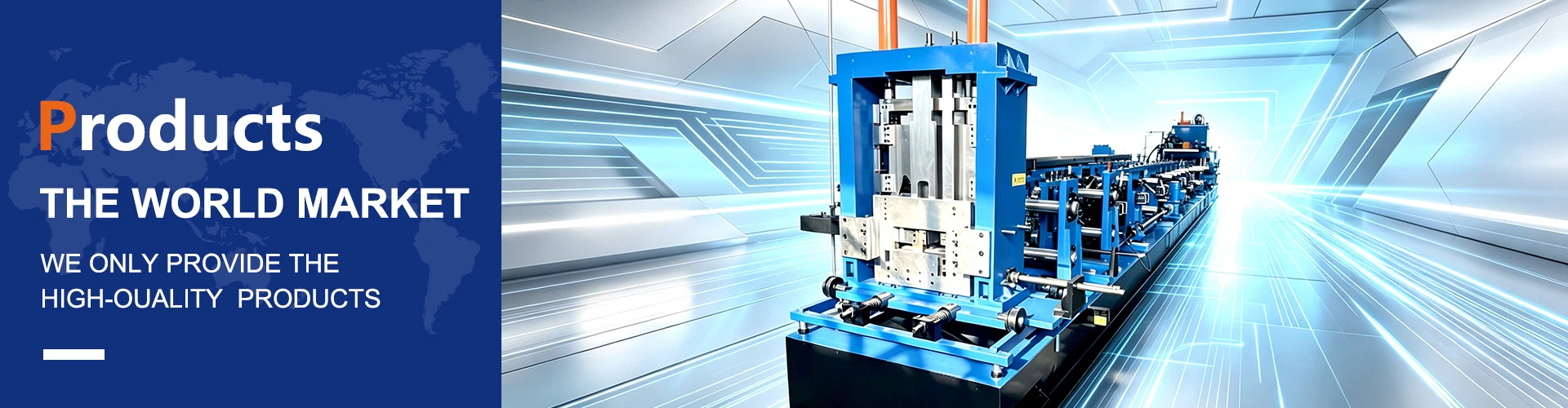

Product Overview
Automated roll forming line for high-precision production of C, U, and custom profile roof truss members from galvanized or coated steel coils. Integrated processing incorporates decoiling, leveling, servo-driven punching, precision roll forming, and hydraulic cut-to-length operations into a continuous workflow. Profile dimensions, hole matrices, and component lengths are executed via automated control systems matching approved CAD engineering drawings.
Technical Specifications
|
Parameter |
Specification |
|
Processed Profile |
C, U, and custom cold-formed sections |
|
Material Thickness |
0.5–2.0 mm |
|
Material Yield Strength |
G300–G550 galvanized / coated steel coil |
|
Production Speed |
15–30 m/min (profile- and punching-dependent) |
|
Length Tolerance |
±1.0 mm |
|
Punching Accuracy |
±0.5 mm |
|
Main Transmission |
Gear / Gearbox transmission |
|
Roller Material |
Cr12 / D2 tool steel, vacuum heat-treated |
|
Shaft Diameter |
Solid shaft, engineered to profile load requirements |
Core Product Advantages
Rapid Servo Auto-Width Adjustment: Optional PLC-driven servo changing system reduces profile size changeovers to under 5 minutes without manual roller disassembly.
High Punching & Cutting Precision: Servo positioning combined with high-resolution encoders achieves hole placement accuracy of ±0.5 mm and length tolerances within ±1.0 mm per 6-meter profile.
Durable Tooling & Surface Protection: Rollers made of Cr12MoV/SKD11 die steel are vacuum heat-treated (HRC 58–62) and hard-chrome plated, forming high-strength steel (Yield Strength <= 550 MPa) without damaging the galvanized coating.
Low Material Scrap Rate: Continuous integrated punching, roll forming, and shearing combined with software nesting algorithms keep raw material waste below 1.5%.
Applications
- Factory-assembled roof trusses for residential and low-rise commercial framing
- Panelized modular building systems and off-site prefabrication
- Cold-formed structural framing components for light industrial units
- Portable building units and disaster relief housing modules
Production Process Flow
Decoiling & Leveling: Coil material feeds through leveling rollers to eliminate strip curvature before processing.
Servo Feeding & Punching: High-precision servo drives position the strip for accurate automatic punching of connection holes and service openings.
Roll Forming: Gradual bend progression through hardened tool steel rollers ensures profile straightness and dimensional consistency.
Cutting & Discharge: Flying hydraulic cut-off shears members to exact programmed lengths without profile deformation.
Roll Forming System Design
Roller stations are calculated based on material yield strength, profile height, and lip geometry to eliminate oil-canning, twisting, or flange flare.
Precision Tooling: Cr12MoV tool steel rollers hardened to HRC 58-62 ensure dimensional stability over long production runs.
Structural Rigidity: Independent steel side-wall stands reduce frame deflection under high-yield steel stress.
Surface Protection: Chrome-plated roller surface prevents galv-off on galvanized steel coils.
Control System
The PLC control architecture supports single-piece, batch, and complete truss file execution.
Data Entry: Industrial touchscreen for manual batch entry or USB/Network import of BIM framing files (.NC1 / CSV).
Control Features: Real-time production tracking, speed adjustment, piece counting, fault diagnostics, and emergency stop loops.
Remote Support: Integrated IoT gateway modules allow remote PLC diagnostics and firmware updates.
Line Capabilities
Direct BIM Import: Compatible with structural design outputs from Vertex BD, Framecad, and MWF to automate hole positioning and member cutting.
Integrated Processing: Eliminates separate layout, punching, drilling, and manual cutting steps.
Tight Tolerances: Servo-driven positioning maintains member length accuracy within +/-1.0 mm and punch location accuracy within +/-0.5 mm.
Flexible Batching: Run varying member lengths and punching configurations within the same production schedule without mechanical re-tooling.
Testing Standards
Every machine undergoes operational testing prior to shipment:
Mechanical Audit: Frame alignment, roller parallelism, shaft concentricity, drive chain tension.
Trial Run: Sample production using buyer-specified steel coil grade and thickness.
Output Verification: Flange dimensions, profile straightness, hole center-to-center distance, cut length tolerance against CAD drawings.
fAQ
Q: What coil materials can be processed?
A: Galvanized (GI), Galvalume (AZ), and pre-painted steel coils with yield strengths ranging from 300 MPa to 550 MPa.
Q: How does the control system handle production data?
A: The PLC system directly ingests standard export files (.NC1, .CSV) from LGS design software via USB or Ethernet network interface.
Q: What is the standard tolerance for punching and cutting length?
A: Punching position tolerance is within ±0.5 mm. Cut-to-length precision is within ±1.0 mm for a 6-meter profile.
Q: How are profile dimension changes accommodated?
A: Lines feature either manual spacer/sleeve adjustments or fully automated servo-driven width changes managed through the HMI interface.
Hot Tags: light gauge steel roof truss roll forming machine, China light gauge steel roof truss roll forming machine manufacturers, suppliers, factory