


How to Make Roof Sheets?
Author:[2026-10-02] | By Xiamen Tacon Forming Machinery Co., Ltd. Henry Liu sales@taconmachinery.com
Roof sheets are normally produced by feeding a galvanized, galvalume, or color-coated steel coil through a Cold Roll Forming Machine, where successive roll stations gradually bend the strip into the specified roofing profile. For common roofing materials around 0.3–0.8mm thick and 914–1250mm wide, the forming sequence, roller geometry, feed accuracy, and cutting method determine the final panel dimensions and surface quality.
1. Select the Roofing Material and Coil Specification
Before the machine is selected, define the coil rather than starting with the finished roof sheet. Material grade, coating, thickness, yield strength, coil width, and surface coating all affect the forming load and roller design.
Typical roofing coils include galvanized steel, galvalume steel, pre-painted steel, aluminum, and, for specific applications, stainless steel. In many commercial roofing applications, galvanized and color-coated steel are widely used because they combine structural strength, corrosion protection, availability, and relatively low material cost.
Typical Metal Roofing Coil Parameters
| Parameter | Common Range / Option | Engineering Consideration |
|---|---|---|
| Material | Galvanized steel | Zinc coating provides corrosion protection |
| Material | Galvalume steel | Aluminum-zinc coating for corrosion resistance |
| Material | Pre-painted steel | Requires careful surface protection during forming |
| Material | Aluminum | Lower forming load but different springback behavior |
| Thickness | 0.3–0.8 mm | Machine tooling must match the selected gauge |
| Coil Width | 914–1250 mm | Determined by finished profile and coil slitting |
| Forming Method | Cold roll forming | Normally performed at room temperature |
| Feedstock | Coiled strip | Continuous production is typical |
| Finished Product | Roofing panel | Profile geometry is determined by roll tooling |
For a production line, the yield strength should also be specified. Two coils with the same nominal thickness can require different forming forces if their mechanical properties differ significantly.
Galvanized, Galvalume and Color-Coated Steel
Galvanized steel uses a zinc coating over the steel substrate. Galvalume uses an aluminum-zinc coating system. Pre-painted roofing coil adds a coating layer that provides color and additional surface protection.
The material selection affects more than corrosion resistance. It also influences:
- Springback after each forming pass
- Required roll gap
- Forming load
- Surface marking risk
- Edge deformation
- Final profile recovery
- Roller coating requirements
A roofing machine should therefore be specified against the actual coil specification instead of simply stating "metal sheet."
2. How a Cold Roll Forming Machine Makes Roof Sheets
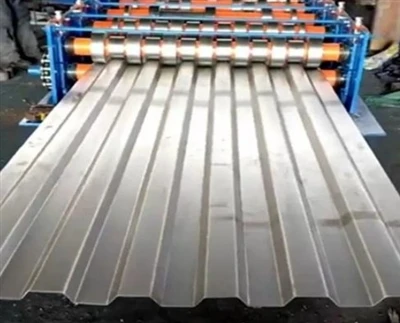
A Cold Roll Forming Machine does not create the roofing profile in one operation. The strip passes through a sequence of forming stations, with each pair of rollers introducing a controlled amount of deformation.
The basic production route is:
Coil → Decoiling → Straightening/Guiding → Roll Forming → Optional Embossing → Cutting → Run-Out
At the entry section, the decoiler releases the coil at a controlled rate. Guide rollers then center the strip before it enters the first forming station.
Each subsequent roll station changes the cross-section by a small increment. The final stations establish the finished rib height, valley geometry, side lap, overlap detail, or other profile features.
Progressive Forming Controls Profile Stress
A roof sheet profile with deep ribs cannot normally be produced by forcing the flat strip into its final geometry at the first station. Excessive deformation in one pass can create:
- Edge waves
- Profile twisting
- Excessive springback
- Rib distortion
- Oil canning
- Surface coating damage
Progressive forming distributes the deformation over multiple stations.
The exact number of stations depends on the profile geometry, material thickness, yield strength, rib depth, flange width, and required production speed.
3. Main Components of a Metal Roofing Roll Former
A production-grade roofing machine contains several mechanical and control assemblies. Their configuration depends on the required roof profile, material specification, production rate, and cutting method.
3.1 Hydraulic or Mechanical Decoiler
The decoiler supports the incoming steel coil and feeds the strip into the forming line.
A typical industrial decoiler may use:
- Hydraulic expansion
- Pneumatic or hydraulic braking
- Coil side arms
- Coil centering guides
- Automatic tension control
- Maximum coil weight matched to the production line
For heavier coils, hydraulic expansion provides controlled mandrel engagement and reduces manual handling.
3.2 Entry Guide and Feeding System
The entry guide keeps the coil centered before it reaches the first forming stand.
Incorrect lateral alignment at this stage can become more pronounced as the strip travels through the forming stations. For asymmetric roof profiles, guide adjustment is particularly important because unequal forming loads can generate profile drift.
3.3 Forming Rollers and Stations
Forming rollers are the working components that progressively bend the strip.
Common roller materials include alloy steel and hardened steel, with surface treatment selected according to the material and coating requirements.
| Roller Option | Typical Application | Main Engineering Point |
|---|---|---|
| 45# steel | General roll forming | Economical machine tooling |
| GCr15 | Higher wear resistance | Suitable for demanding tooling |
| Cr12 / Cr12MoV | High-wear tooling | Higher hardness after heat treatment |
| Hard-chromed roller | Coated roofing sheets | Reduced surface marking and corrosion |
| Stainless steel tooling | Special applications | Used where surface or corrosion requirements justify it |
Roller material should not be selected independently from the roofing coil. Pre-painted steel, for example, requires greater attention to roller surface finish and contamination control.
3.4 Drive Rollers and Transmission
The drive system moves the strip through the forming line while maintaining synchronized rotation between stations.
Two common transmission arrangements are chain drive and gearbox drive.
| Transmission | Advantages | Engineering Considerations |
|---|---|---|
| Chain drive | Simple construction and lower initial cost | Chain wear and lubrication require monitoring |
| Gearbox drive | Positive torque transmission and synchronized rotation | Higher mechanical cost and greater assembly precision |
| Individual motor drive | Flexible station control | More complex electrical and control architecture |
For high-throughput roofing production, gearbox transmission can provide stable torque transfer between forming stands when correctly sized for the material and profile.
4. Forming Stations, Springback and Oil Canning Control
Roofing sheet quality is strongly affected by the forming schedule.
Gradual Bending Reduces Local Stress
A forming station should only introduce the amount of deformation that the material can accept without excessive local strain. The roll tooling therefore follows a planned flower pattern.
A simplified sequence might progress from:
Flat Strip → Edge Pre-Bending → Side Rib Formation → Main Rib Formation → Profile Calibration → Final Dimension
The actual sequence depends on the roofing profile.
Springback Compensation
Steel attempts to recover part of its original geometry after leaving the forming roll. This elastic recovery is known as springback.
Springback becomes more noticeable when:
- Yield strength increases
- Material thickness decreases
- Bend radius becomes smaller
- Profile geometry becomes asymmetric
- Forming strain is concentrated in fewer stations
Roll tooling can compensate for expected springback by adjusting the forming geometry at later stations.
The objective is not to eliminate material elasticity. It is to predict it and incorporate the expected recovery into the roll design.
Controlling Oil Canning
Oil canning refers to visible waviness or distortion across relatively flat portions of a metal panel.
A well-controlled forming process can reduce the risk through:
- Sufficient forming stations
- Balanced edge deformation
- Correct roll gaps
- Controlled strip alignment
- Appropriate forming radii
- Avoidance of excessive localized deformation
For thin roofing sheets, roller design and forming sequence can have a greater influence on visible flatness than simply increasing machine speed.
Request a Roof Profile Engineering Review
5. Roof Sheet Cutting: Pre-Cut vs Post-Cut
Once the roofing profile reaches the specified length, the production line must separate the finished panel from the continuous strip.
Two basic cutting arrangements are commonly used.
Post-Cut System
The sheet is fully formed first and then cut to length.
Advantages:
- Suitable for continuous roll forming
- Flexible finished lengths
- No short-length limitation caused by pre-cutting
- Suitable for many standard roofing profiles
Hydraulic cutting can be used where the required cutting force exceeds the practical capacity of a mechanical shear.
Pre-Cut System
The flat strip is cut before entering the roll-forming stations.
This can produce a clean cut on the flat material, but the minimum finished length and production sequence must be considered during machine design.
| Cutting Method | Cutting Position | Main Benefit | Main Limitation |
|---|---|---|---|
| Pre-cut | Before forming | Clean flat-sheet cut | Finished-length limitations |
| Post-cut | After forming | Flexible panel lengths | Cutting die must match formed profile |
| Hydraulic cut | Depends on machine layout | High cutting force | Requires hydraulic system |
| Servo flying shear | During continuous movement | Higher production efficiency | More complex control and synchronization |
For automated roofing lines, the cutting system must remain synchronized with the actual strip speed. Poor synchronization can produce inaccurate lengths or damaged panel ends.
6. PLC Control and Automatic Roof Sheet Production
A modern roof panel roll forming machine uses a PLC control system to coordinate feeding, forming, punching where required, cutting, and production counting.
The operator normally enters:
- Required panel length
- Production quantity
- Cutting parameters
- Line speed
- Punching position, if applicable
The PLC receives encoder feedback and controls the cutting sequence when the programmed length is reached.
Typical Control Architecture
| Control Function | Purpose |
|---|---|
| PLC | Machine sequence and logic control |
| HMI touchscreen | Parameter input and machine monitoring |
| Encoder | Length measurement |
| Inverter | Motor speed regulation |
| Proximity sensors | Position and safety feedback |
| Emergency stop | Immediate machine shutdown |
| Hydraulic control | Cutting or auxiliary hydraulic functions |
For export machinery, the electrical system should be specified according to the installation country, including voltage, frequency, phase configuration, control voltage, cabinet standards, and component availability.
7. Quality Inspection Before Roof Sheet Production
Before commercial production begins, the roofing line should be checked with the actual or representative material.
FAT Inspection Points
- A factory acceptance test should include measurable checks such as:
- Coil feeding stability
- Forming station alignment
- Roller concentricity
- Shaft runout
- Gearbox operation
- Motor current under load
- Finished profile dimensions
- Panel length accuracy
- Cut quality
- Surface coating condition
- Emergency-stop operation
- PLC counting accuracy
A finished roofing panel should be measured at several positions along its length. Checking only one short sample can hide progressive profile drift.
Dimensional Inspection Table
| Inspection Item | Typical Measurement Method |
|---|---|
| Panel width | Steel ruler / digital measurement |
| Rib height | Vernier caliper / profile gauge |
| Rib pitch | Digital measurement |
| Panel length | Tape measure / encoder comparison |
| Straightness | Straightedge / reference line |
| Edge condition | Visual and dimensional inspection |
| Coating condition | Visual inspection under controlled lighting |
| Cut end | Visual and dimensional inspection |
The final acceptance tolerance should come from the customer's approved technical drawing and applicable roofing standard rather than from a generic machine specification.

8. Why Steel Roofing Remains Widely Used
Steel roofing combines relatively low material cost with useful structural and environmental properties.
Advantages
- High strength-to-weight ratio
- Wide range of coating options
- Available in many colors and profiles
- Suitable for long continuous panels
- Recyclable steel substrate
- Compatible with automated roll forming
- Suitable for residential and industrial construction
Galvanized and coated steel also provide a practical balance between material availability and corrosion resistance when the coating specification is matched to the building environment.
Limitations
Metal roofing also requires appropriate engineering and maintenance.
Potential issues include:
- Corrosion after coating damage
- Thermal expansion and contraction
- Surface scratching during handling
- Noise from rain without suitable insulation
- Condensation if the roof assembly is poorly designed
- Profile deformation caused by incorrect forming
The roofing material, coating system, fasteners, underlayment, insulation, and installation method should therefore be considered as one roof assembly.
9. Portable vs Factory-Based Cold Roll Forming Machines
Not every roofing project requires the same machine layout.
A fixed factory line is suitable when large volumes of standardized roofing panels are produced. A portable roll former can be useful when long panels are manufactured close to the construction site to reduce transportation requirements.
| Factor | Factory Roll Former | Portable Roll Former |
|---|---|---|
| Production environment | Permanent factory | Job site / temporary production area |
| Mobility | Low | High |
| Production volume | High | Project-dependent |
| Panel length | Broad range | Often optimized for on-site production |
| Automation | Higher | Depends on configuration |
| Coil logistics | Factory handling | Site-based coil handling |
| Typical use | Continuous commercial production | Long-panel construction projects |
The correct machine depends on the production volume, panel length, available power, coil logistics, transport cost, and required profile.
10. How to Specify a Cold Roll Forming Machine for Roof Sheets
A machine supplier should receive the engineering information below before preparing a final quotation.
Required Input Data
- Roof panel cross-sectional drawing
- Material type
- Material thickness
- Yield strength
- Coil width
- Coating specification
- Required forming speed
- Finished panel length
- Production volume
- Punching requirements
- Embossing requirements
- Cutting method
- Electrical voltage and frequency
- Factory floor space
- Coil weight
- Maximum coil outside diameter
A profile drawing is especially important. Two roof panels can have similar visual appearances but require different roller geometry, forming sequences, shaft loading, and cutting dies.
11. China Cold Roll Forming Machine Manufacturer: Xiamen Tacon
Xiamen Tacon Forming Machinery Co., Ltd. manufactures cold roll forming equipment for roofing panels, wall panels, C/Z purlins, light steel sections, and other cold-formed steel profiles.
The engineering scope can cover the complete forming process, from decoiling and entry guiding through roll forming, punching, cutting, and run-out handling. Machine configuration can be developed around the customer's actual material specification and profile drawing rather than relying solely on standard machine dimensions.
For overseas projects, the machine specification should also include electrical configuration, PLC language, safety requirements, spare parts, installation documentation, factory testing, and export packing.
Send Your Roof Profile for Engineering Review
12. Frequently Asked Questions About Making Roof Sheets
What thickness of steel can a roof sheet roll forming machine process?
A typical roofing line can process approximately 0.3–0.8mm steel, but the actual range depends on the profile, material grade, yield strength, forming station design, shaft capacity, and roller geometry. The machine should be engineered around the buyer's actual coil specification.
How many forming stations are needed for a metal roofing profile?
There is no fixed station count for every roof sheet. Deep ribs, narrow radii, high-strength steel, asymmetric profiles, and surface-sensitive coatings generally require a carefully distributed forming sequence. The final station count should be established from the profile drawing and material properties.
Is post-cut or pre-cut better for roof sheet production?
Post-cut systems provide greater flexibility for finished panel lengths because cutting occurs after the profile has been formed. Pre-cut systems can provide a clean cut on flat strip but introduce restrictions that must be considered when specifying minimum panel length and production sequencing.
Factory-Direct Roof Sheet Machine Inquiry
Send Xiamen Tacon the roof profile drawing, coil thickness, material grade, yield strength, coil width, required panel length, production speed, and destination-country electrical standard. The engineering team can use these inputs to determine the forming sequence, roller tooling, drive configuration, cutting method, and machine layout for your production line.